An AEO agency makes your brand the source that AI answer engines (Google AI Overviews, AI Mode, ChatGPT, Perplexity and Copilot) cite and recommend when buyers ask questions in your category. The work combines technical SEO, entity and schema work, answer-first content and third-party citations, and it should be judged on citations and qualified leads, not rankings alone.
That is the short answer. The rest of this guide covers why the question matters now, what the work looks like month to month, and the eight questions to put to any AEO agency before you sign.
Why are businesses looking for an AEO agency now?
Because the click is getting harder to win, and the numbers are public.
- 68.01% of US Google searches ended without a click in January to April 2026, up from 60.45% in 2024 (SparkToro, using Similarweb panel data for 2026 and Datos for 2024. The panels differ, so treat the comparison as approximate).
- 25.11% of searches triggered an AI Overview in a sample of 21.9 million Google searches (Conductor, 2026 AEO / GEO Benchmarks Report, US data, 15 September to 12 October 2025).
- In the UK, clickthrough rate fell 47.5% on desktop and 37.7% on mobile when an AI Overview appeared (Authoritas study of 3,500 UK search terms, 16 to 22 April 2025, reported by Press Gazette).
Now the counterweight. AI referrals are still small: 1.08% of all website traffic across 13,770 domains, with ChatGPT sending 87.4% of it (Conductor, US data, May to September 2025).
So the honest picture is this: AI answers are reshaping what happens on the results page far faster than they are sending visits. Any agency that tells you AI traffic will replace organic traffic next quarter is not reading the data. The real prize is being the named, cited source when a buyer asks an AI tool who to shortlist.
What does an AEO agency actually do?
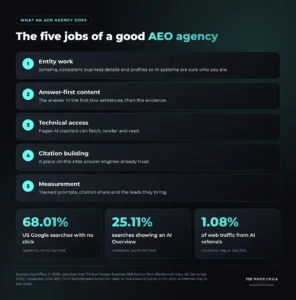
Good AEO work falls into five jobs. If a proposal is missing two or more of them, it is probably SEO with a new label.
1. Entity work
AI systems need to be confident about who you are, what you sell and where you operate. An agency should audit and fix your Organization, Service, Person and FAQ schema, align your name, address and descriptions across profiles, and close gaps between what your site says and what third parties say about you.
This is the same groundwork that moves classic SEO. For Kotak Mutual Fund we added fund manager author bios and reviewer markup, rewrote 300+ pages in plain language and fixed slow page loads; organic clicks grew 321% (Kotak Mutual Fund case study).
2. Answer-first content
Pages are restructured so the answer comes first, in two or three plain sentences, followed by the evidence. Expect question-style headings, short definitions, comparison tables, original data and named authors with real credentials. This is where EEAT content writing stops being optional.
3. Technical access
If crawlers cannot fetch, render and parse a page, it cannot be cited. That means checking robots rules for AI crawlers, server-side rendering of key content, page speed, clean internal linking and canonical tags. A technical SEO audit is usually the first deliverable.
4. Citation building
Answer engines lean on sources they already trust. The agency should identify which domains get cited for your priority questions, then earn your place on them through digital PR, expert commentary, reviews, industry directories and useful contributions on community platforms.
5. Measurement
You should receive a tracked list of prompts and questions, your citation and mention share against named competitors, AI referral sessions in GA4, and the leads or revenue attached to them. Rankings still belong in the report, but they are no longer the headline.
Is an AEO agency different from an SEO agency?
Less than the marketing suggests. (For short definitions, see our glossary entries on AEO and GEO.) Most of the work is disciplined SEO: crawlability, content quality, authority. What differs is the target and the scoreboard.
- Goal: an SEO agency works to rank a page. An AEO agency works to get you cited in the answer.
- Unit of work: keywords for SEO, questions and prompts for AEO.
- Content shape: a long page built around a term, versus a direct answer followed by proof.
- Authority signal: links, versus links plus brand mentions and citations.
- Headline metric: position and clicks, versus citation share and assisted leads.
If you want the longer explanation of the discipline itself, read our guide to answer engine optimisation in 2026.
8 questions to ask an AEO agency before you hire
- Which prompts will you track for us, and how did you choose them? A serious answer starts from your sales conversations and Search Console queries, not a generic list.
- How do you measure citation share? Ask which engines are covered, how often prompts are re-run and how they handle the fact that AI answers vary between sessions.
- Can you show a before and after for a client? Screenshots of one lucky answer are not evidence. Look for a tracked prompt set over several months.
- What will you change on our site in the first 30 days? You want specifics: schema fixes, page rewrites, crawl access.
- How do you earn third-party citations? If the answer is paid link packages or mass forum posting, walk away.
- How does this connect to our existing SEO and paid activity? AEO run as a silo duplicates cost. It should share one content plan and one reporting view.
- What will you report monthly, and what counts as success at 90 days? Agree the baseline before work starts.
- What can you not control? A straight agency will say that no one can guarantee inclusion in an AI answer.
Red flags to watch for
- Guaranteed placement in ChatGPT or AI Overviews
- A separate “AI content” package with hundreds of pages a month (scaled content abuse is a live Google spam policy)
- No baseline measurement before the retainer begins
- Reporting that shows only impressions, never leads
- No named person accountable for strategy
What results should you expect, and when?
Month one should produce a baseline: which questions matter, who is cited today and where your site blocks or confuses crawlers. Technical and schema fixes follow first because they are fastest to ship. Content restructuring and citation building compound more slowly.
On value, one data point is worth knowing. Conductor’s report cites Knotch’s observation that visitors referred by large language models convert at twice the rate, in a third of the sessions, compared with other sources. That is a single vendor’s client data, not a market benchmark, but it matches the logic: someone who arrives after an AI tool has recommended you is already part way through the decision.
AEO in the UK
UK buyers see AI Overviews on a meaningful share of informational searches, and the Authoritas figures above show what that does to clicks. For B2B, fintech and professional services firms, the priority is being cited for comparison and “best for” questions, written in British English with UK pricing, regulation and case evidence. US-flavoured content is easy for both readers and machines to discount.
AEO in the UAE and Dubai
Dubai searches are bilingual and heavily local. Brands need consistent entity data in English and Arabic, accurate Google Business Profile listings for every branch, and content that answers location-specific questions (areas, free zones, delivery coverage, licensing). Hospitality, real estate and ecommerce brands gain most from pairing AEO with strong local SEO.
AEO in India
Indian buyers often research in a mix of English and regional languages, on mobile, and increasingly through AI assistants. Enterprise and D2C brands should focus first on entity clarity (many Indian brands have inconsistent names across listings), then on answer-first content for high-intent category questions. Budgets go further when AEO is planned alongside existing SEO work instead of being bought as a new retainer.
Working with The White Chalk Media
We treat AEO as an extension of performance SEO: one plan, one report, leads as the measure. If you want a baseline of where your brand is and is not cited today, see The White Chalk Media’s AEO service and request the free AI-era audit.
Frequently asked questions
What does AEO stand for?
AEO stands for answer engine optimisation. It is the practice of structuring your site, content and brand signals so that AI answer engines such as Google AI Overviews, ChatGPT and Perplexity cite and recommend you.
Is an AEO agency different from an SEO agency?
Most of the foundations are shared. An AEO agency adds prompt tracking, entity and schema work, answer-first content formats and citation building, and it reports on citation share and leads as well as rankings.
How do you measure AEO results?
Track a fixed set of prompts across the main answer engines, record how often your brand is cited or mentioned against competitors, and connect AI referral sessions in GA4 to enquiries and revenue.
Do small businesses need an AEO agency?
Not always. A small business with a sound site can start by fixing schema, answering customer questions clearly on key pages and keeping listings consistent. An agency makes sense when competitors are already being cited and you are not.
