
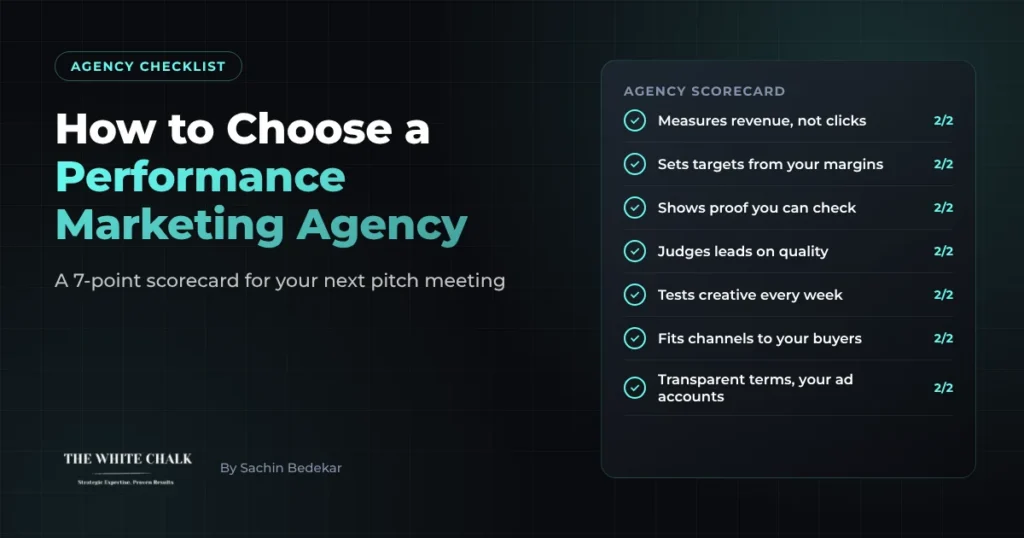
Choose a performance marketing agency on whether it measures what your business actually earns, not what the ad platforms report, and whether it can prove that with named results. This guide turns that into seven checks you can take into any pitch meeting.
Most agency pitches look alike: a dashboard, a few logos and a promise to “scale”. The differences that matter only show up when you ask specific questions. Here they are, with what a good answer sounds like and the red flags to listen for.
The seven-point scorecard
1. Does it measure revenue, or clicks?
Ask how the agency will connect ad spend to sales or qualified leads. A good answer covers GA4 key events, offline conversions sent back from your CRM, and a clear view of which channel gets credit for a sale. If you are unsure what that last part means, our glossary entry on attribution explains it in two minutes.
- Good answer: “We will import approved applications or orders from your CRM, so Google and Meta optimise for customers, not form fills.”
- Red flag: the main report is platform ROAS and click-through rate, with no link to your sales data.
2. Will it set targets from your margins?
A healthy-looking ROAS can still lose money. Ask the agency to work out your break-even ROAS and a target customer acquisition cost before it spends anything. Break-even ROAS is simply 1 divided by your gross margin: at a 40% margin, you need a ROAS of 2.5 just to cover the ads. See our definitions of ROAS and CAC for worked examples.
- Good answer: targets in rupees of profit or cost per customer, agreed in writing.
- Red flag: “We’ll aim for a 4x ROAS” without asking about your margins.
3. Can it show proof you can check?
Ask for case studies with a named client, the metric and what was done. Logos alone prove nothing. For example, for Turtlemint’s two-wheeler insurance campaigns we cut CPA from ₹1,500 to ₹500 while transaction volume grew 150% (Turtlemint case study). For HDB Financial Services, regional-language campaigns and a shorter loan application lifted loan enquiries 250% and cut CPA by 40% (HDB case study).
- Good answer: two or three case studies close to your industry, with numbers you can ask about.
- Red flag: results shown only as screenshots, or “we can’t share client names” for every example.
4. Does it judge leads on quality?
Cheap leads that never convert are expensive. Ask how the agency will measure lead quality and how often it talks to your sales or counselling team. At ITM Group of Institutions, a regular feedback loop with the counselling team lifted the conversion rate by 35% and brought CPA down from ₹1,500 to ₹900 (ITM case study).
- Good answer: a verified or sales-qualified lead count alongside raw leads, reviewed weekly with your team.
- Red flag: success is reported as “number of leads” only. Read more on cost per lead.
5. Who makes the creative, and how often does it change?
On Meta and YouTube in particular, creative drives results more than targeting settings. Ask who produces ads, how many new versions are tested each month and how winners are chosen.
- Good answer: a fixed testing rhythm (for example, new hooks every week) judged on cost per purchase or per qualified lead.
- Red flag: “Send us your brand assets and we’ll take it from there.”
6. Does the channel mix fit your buyers?
Search captures people already looking for you. Meta and Instagram create demand. LinkedIn reaches B2B decision-makers. Marketplaces and Shopping campaigns matter for ecommerce. Ask why the agency recommends each channel for your business specifically.
- Good answer: a channel plan tied to how your customers buy, with a budget split you can question.
- Red flag: every client gets the same plan, usually whatever the agency is strongest at.
7. Are the terms transparent?
Ask four practical questions:
- Are the ad accounts in your company’s name, with you as owner?
- How is the fee calculated?
- What is the notice period?
-
What happens to data, creative and landing pages if you part ways?
-
Good answer: you own the accounts and data, the fee model is written down, and you can leave with everything.
- Red flag: the agency owns your ad accounts, or the contract runs a year with no exit.
How agency fees usually work
There are four common models. None is right for everyone.
- Fixed monthly retainer: predictable, and the agency is not rewarded simply for raising spend.
- Percentage of ad spend: scales with budget, but check the incentive to spend more.
- Hybrid: a smaller retainer plus a percentage, common for growing accounts.
- Performance-linked: part of the fee tied to agreed outcomes such as qualified leads. Only works when tracking is solid and both sides agree the definitions.
Whichever you choose, make sure the fee is judged against cost per customer and profit, not clicks.
Use the scorecard in your next pitch
Score each agency from 0 to 2 on the seven checks. Anything below 10 out of 14 needs a hard look. Ask every agency the same questions in the same order, and write down the answers. The differences become obvious quickly.
In the UK
UK buyers often compare several agencies side by side and expect clear pricing. Weight checks 2 and 7 heavily, and ask how the agency handles UK-specific rules such as financial promotion requirements if you are in a regulated sector.
In the UAE
UAE campaigns often need English and Arabic creative and audiences split by emirate and nationality. Ask the agency to show bilingual work and how it handles seasonal peaks such as Ramadan.
In India
Indian brands usually face a quality problem more than a volume problem. Push hard on checks 1 and 4, and ask how the agency reaches Tier 2 and Tier 3 cities, where regional-language ads often matter. If you want to see how we approach this, our pages on performance marketing for BFSI and fintech and performance marketing for education show the work in detail, and The White Chalk Media’s performance marketing service explains how we run accounts.
FAQ
What does a performance marketing agency do?
It plans, runs and optimises paid campaigns on channels such as Google, Meta and LinkedIn, and is judged on measurable outcomes like leads, sales and cost per customer rather than reach alone.
How do I compare performance marketing agencies?
Ask every agency the same seven questions: how it measures revenue, how it sets margin-based targets, what proof it has, how it judges lead quality, how it handles creative, why it recommends each channel and what the contract terms are.
Should I own my ad accounts?
Yes. The Google Ads, Meta and other ad accounts should be in your company’s name, with you as owner and the agency as a user. That protects your data and history if you change agencies.
How long before a new agency shows results?
Tracking and wasted-spend fixes can show within weeks. Creative testing and funnel improvements build over a few months, so agree a baseline and a 90-day review before work starts.
Want an outside view of your current setup? Get a free audit.
