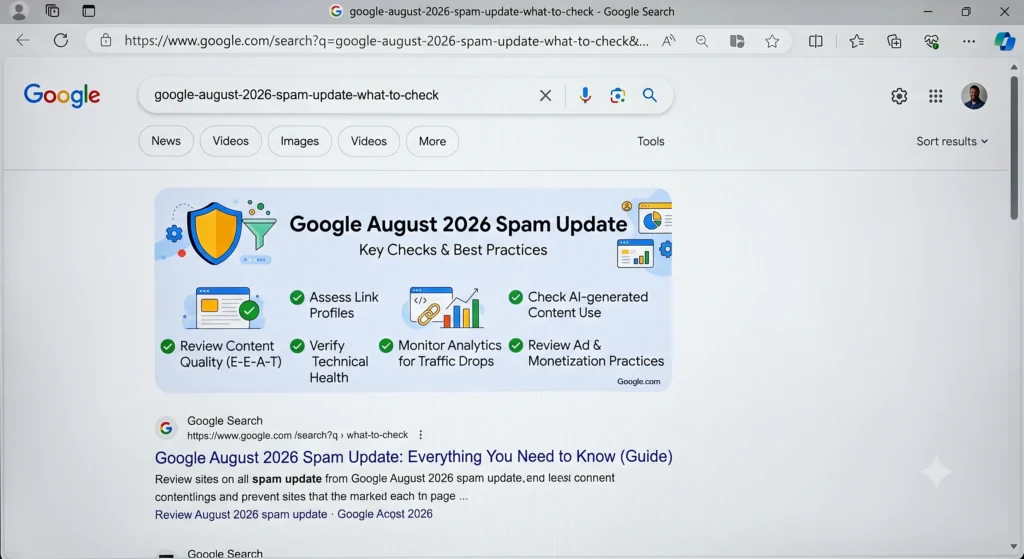
Google confirmed on 21 August that its August 2026 spam update had finished rolling out, closing a rollout that began on 18 August. Start to finish it took roughly two and a half days — in line with the March and June 2026 rollouts, and a world away from the 27-day grind of the August 2025 update.
This is the third spam update Google has announced in 2026, following March and June. Google’s own framing was deliberately unremarkable: a “normal” spam update, applying globally and to all languages, with nothing structurally new beyond running its spam detection systems again. The company pointed site owners at its published spam policies rather than at anything specific to this release.
That framing matters, because it tells you what this update was not. It was not a link spam update. It was not a site reputation abuse action. And it was not a core update — so if your rankings moved, the cause and the fix are different from the ones you would reach for after a broad core release.
What People Actually Saw
The reported impact was uneven, which is typical of spam updates and typical of the reporting around them. In the SEO community, complaints ran to the dramatic end: traffic “decimated,” problems with discovery and news indexing, and niche specialist sites reporting they had been displaced in the SERP by large retailers selling only tangentially related products. Several site owners described organic listings being pushed well below the fold.
Others reported the opposite. At least one operator noted that this rollout appeared to correct a false positive from an earlier update — their site came back.
Both things can be true at once. Spam updates re-run detection across the whole index, which means they restore sites that were wrongly caught as often as they demote sites that were not caught before. The honest read at this stage: the volatility was real but narrower than a core update, and the anecdotal reports are not yet backed by a systematic dataset.
Why This One Lands Differently Than It Would Have Two Years Ago
The context around every ranking movement in 2026 is that the clicks were already leaving.
SparkToro’s analysis of Similarweb clickstream data found that 68.01% of US Google searches in the first four months of 2026 ended without a click — up from 60.45% in 2024, the sharpest two-year jump in a decade. Clicks to the open web fell by 9.51 percentage points over the same period, roughly a 23% decline in traffic reaching independent sites. AI Overviews now appear on more than a fifth of searches, and when they do, click-through rates drop by close to 60%.
So a site that lost visibility in the August update is losing a share of a pool that is already shrinking. The remedial work is the same as it has always been — but the margin for treating it casually has gone.
Five Checks to Run This Week
1. Separate the Dates
Pull Search Console performance data and compare 11–17 August against 18–24 August, segmented by page type and by country. If UK, UAE and India traffic moved together, it is more likely an algorithmic shift; if one market moved alone, look first at local SERP composition and competitor changes in that market.
2. Read the Spam Policies as a Checklist, Not as Prose
Scaled content abuse, expired domain abuse and site reputation abuse are the three that catch legitimate businesses most often. Third-party content sections — sponsored subfolders, coupon directories, “partner” pages — are worth auditing first, because they are frequently owned by someone other than the SEO team.
3. Check Indexing and Discovery Separately from Ranking
Several of the reports centred on discovery and news indexing rather than position loss. Confirm the pages are still indexed before assuming a ranking problem.
4. Look at Who Replaced You
If large retailers or aggregators now occupy your terms, that is a SERP intent shift, not necessarily a penalty against your site, and the response is content and entity work rather than a cleanup.
5. Do Not Make Sweeping Changes Yet
Google’s guidance on spam updates is unchanged: if you were affected, meaningful recovery generally waits for a subsequent update. Panic-pruning content in the week after a rollout removes your ability to diagnose what actually happened.
The Take
A fast, quiet, “nothing new” spam update is exactly the kind of event that separates well-maintained sites from ones running on accumulated shortcuts. Nothing here changes the strategic direction of 2026 — that direction is still visibility inside AI answers and defensible topical authority. But it is a reasonable prompt to audit the parts of your site that nobody owns.
If your organic numbers moved this week and you are not sure which of the five checks above explains it, that is a diagnosis worth doing properly before you touch anything.
