
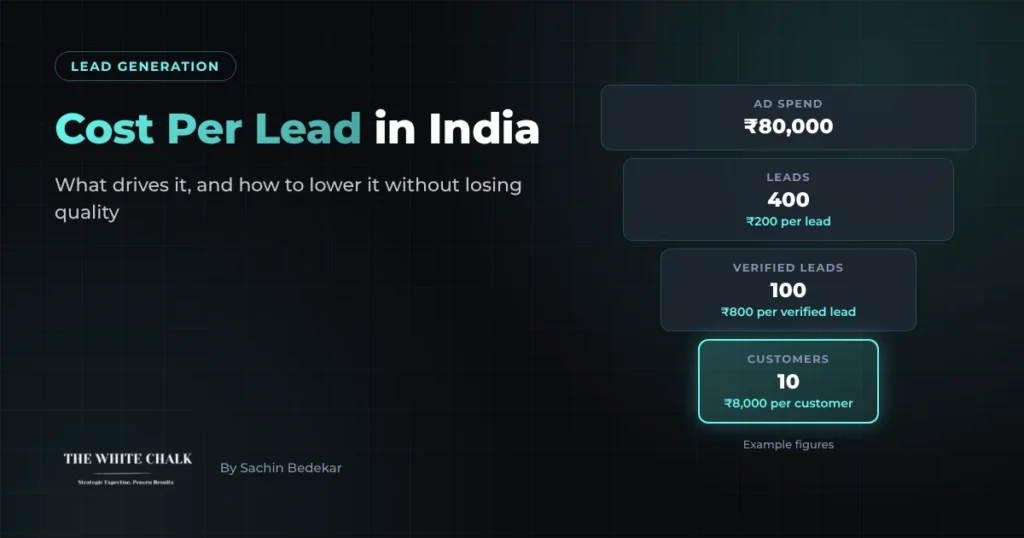
Cost per lead in India depends less on the channel than on your industry, how you define a lead and how well your landing page converts. The number that matters is not the lowest CPL but the cost per lead that turns into a customer you can afford.
This guide covers how to calculate CPL properly, what pushes it up or down, and how to lower it without filling your CRM with leads nobody can reach.
How to calculate cost per lead
The formula is simple:
CPL = campaign spend ÷ leads generated
If you spend ₹80,000 on Meta lead ads in a month and get 400 leads, your CPL is ₹200. Our glossary entry on CPL has more examples.
The difficulty is the word “lead”. A form fill with a fake number and a counselled, interested applicant both count as one lead unless you separate them.
Raw CPL, verified CPL and cost per customer
Track three numbers, not one. Continuing the example above (illustrative figures):
- Raw CPL: ₹80,000 ÷ 400 leads = ₹200
- Verified CPL: if only 100 leads have a working number and real interest, ₹80,000 ÷ 100 = ₹800
- Cost per customer: if 10 of those become customers, ₹80,000 ÷ 10 = ₹8,000
Now compare two campaigns (again, example figures):
- Campaign A: CPL ₹150, and 2% of leads become customers. Cost per customer: ₹150 ÷ 0.02 = ₹7,500.
- Campaign B: CPL ₹400, and 8% of leads become customers. Cost per customer: ₹400 ÷ 0.08 = ₹5,000.
Campaign B looks almost three times as expensive on CPL, yet brings customers at a third less cost. This is why CPL on its own misleads. Work back from the customer acquisition cost your margins can carry, then decide what CPL you can afford.
What drives cost per lead up or down in India
Your industry
Loans, insurance, credit cards, higher education and real estate attract many advertisers bidding for the same searches, so clicks cost more. Local services and niche B2B products usually see less competition.
How wide you target
Broad audiences bring cheap but mixed leads. Tight targeting by intent, location or job role costs more per click but often less per customer.
How you define a lead
Instant lead forms on Meta, with details pre-filled, produce low CPLs and many unreachable numbers. Adding a qualifying question or OTP verification raises CPL and usually lowers cost per customer.
Your landing page
If 2% of visitors convert and you lift that to 3%, your CPL falls by a third at the same spend. Slow pages, long forms and missing trust signals are the usual culprits. Our note on conversion rate shows the maths.
Geography and language
Metro audiences are contested. Tier 2 and Tier 3 cities often cost less to reach but respond better to regional-language ads and to pages that load fast on basic phones.
Season
Admissions intakes, festive sales and financial year-end all change competition. Plan budgets around the windows that matter to your business rather than spending evenly all year.
How to track CPL properly
None of the numbers above are reliable unless tracking is set up end to end. Four steps cover most of it:
- Mark the right actions as key events in GA4. A form submission that reaches your thank-you page, a click-to-call and a WhatsApp click should each be counted, separately, so you can see which channel brings which kind of enquiry.
- Tag every campaign link with UTM parameters. Without them, leads from email, WhatsApp broadcasts and some social placements end up as “direct” or “unassigned”, and their cost is invisible.
- Give every lead an ID that follows it into your CRM. Then you can see, weeks later, which campaign a paying customer came from, not just which campaign produced the form fill.
- Send outcomes back to the ad platforms. Google Ads and Meta both accept offline conversions, so a verified lead or a sale can be reported back and used for bidding.
Once this is in place, review raw CPL, verified CPL and cost per customer every week, campaign by campaign. Our attribution entry explains how the credit for each customer is shared between channels.
Seven ways to lower CPL without losing quality
- Send CRM outcomes back to the ad platforms. Let Google and Meta optimise for verified or approved leads, not raw form fills.
- Cut wasted search terms weekly. Review the search terms report and exclude irrelevant queries.
- Add one qualifying question. Budget, city or timeline filters out casual enquiries.
- Verify numbers. OTP or a quick call-back confirms the lead is real before it counts.
- Fix the landing page before raising spend. Shorter forms, faster loading and visible proof.
- Speak the customer’s language. Regional-language creative in the regions where you sell.
- Test creative every week. New hooks and formats, judged on cost per verified lead.
What it looked like for our clients
These results are from our published case studies. Some are cost per acquisition (CPA), meaning cost per sale or transaction, rather than cost per lead.
- Turtlemint (two-wheeler insurance): CPA cut from ₹1,500 to ₹500, with transaction volume up 150%, through granular bidding, audience segmentation and new ad copy. Read the case study.
- ITM Group of Institutions (PGDM): CPA down from ₹1,500 to ₹900 and conversion rate up 35%, by acting on weekly feedback from the counselling team. Read the case study.
- Certification Planner: cost per lead down 40% and qualified leads up 150%, by focusing search budget on high-intent exam-date queries. Read the case study.
- HDB Financial Services: CPA down 40% while loan enquiries grew 250%, with regional-language targeting and a shorter loan application. Read the case study.
For more detail by sector, see our pages on performance marketing for BFSI and fintech and performance marketing for education.
For UK and UAE readers
The same three numbers apply in pounds or dirhams: raw CPL, verified CPL and cost per customer. In the UK, B2B lead generation often relies on LinkedIn, where clicks are expensive, so lead quality matters even more. In the UAE, bilingual landing pages and WhatsApp follow-up often decide whether a lead becomes a customer, so track WhatsApp enquiries as leads in GA4.
FAQ
What is a good cost per lead in India?
There is no single good number. A good CPL is one that, after your lead-to-customer rate, gives a customer acquisition cost your margins can carry. Work it backwards from what a customer is worth to you.
Why did my cost per lead suddenly go up?
Usually more advertisers competing for the same audience (festive seasons and admissions windows), a landing page change that lowered conversion, or creative that has been shown too often. Check those three before changing budgets.
Are Meta lead forms or landing pages better?
Lead forms usually give a lower CPL and lower lead quality. Landing pages usually cost more per lead and convert better. Test both, adding a qualifying question to forms, and compare on cost per customer.
How is CPL different from CAC?
CPL is the cost of a lead. CAC, customer acquisition cost, is the cost of a paying customer, including the sales effort. CAC is the number your business runs on; CPL is one step towards it.
Want to know what your real cost per customer is? Get a free audit of your tracking and campaigns from The White Chalk Media.
